

Blog
CORVALLIS, Ore. – Researchers for the first time have developed a method to track through the human body the movement of polycyclic aromatic hydrocarbons, or PAHs, as extraordinarily tiny amounts of these potential carcinogens are biologically processed and eliminated.
The Samish Indian Nation invited Blair Paulik (OSU SRP Project 4 Trainee) and Diana Rohlman (OSU SRP CEC Coordinator) to the 3rd annual Fidalgo Bay Science Conference on October 23, 2014.
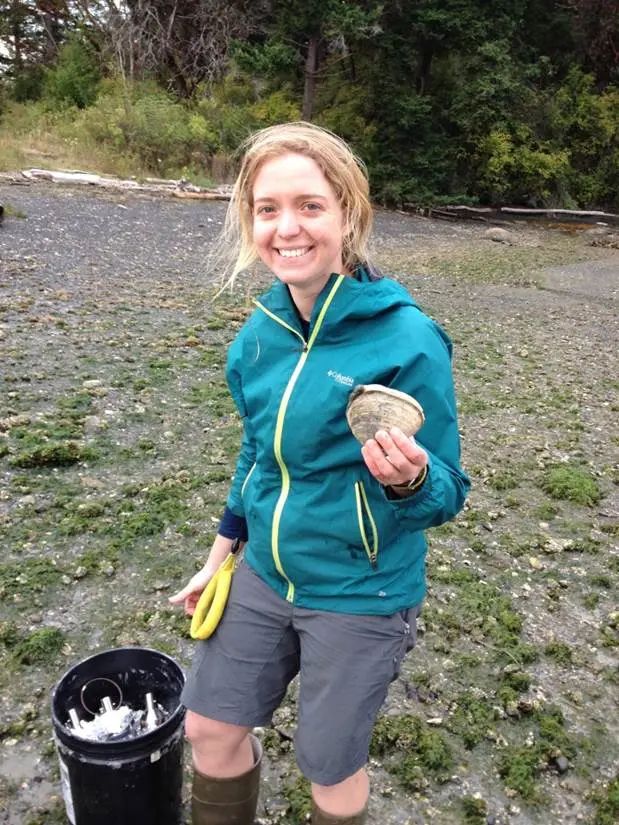
Blair Paulik out in the field with the butter clams.
Dr. David Williams was recently awarded the PANWAT Achievement Award at the 2014 Pacific Northwest Association of Toxicologist Meeting in Bothell, Washington on September 19.
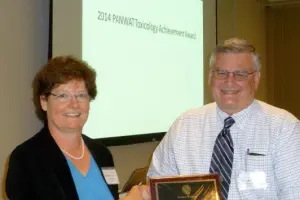
Dr. Williams joined the faculty of the College of Agricultural Sciences in 1987 as an Assistant Professor, originally in Food Science and Technology, then transferring to the Department of environmental and Molecular Toxicology.
On August 20, 2014, Researchers from the Oregon State University (OSU) Superfund Research Program (SRP) have collaborated with two northwestern Tribes, the Swinomish and the Samish, to analyze environmental samples for contaminants. The team worked with Dr. Jamie Donatuto, the Environmental Health Analyst for the Swinomish Tribe, and Christine Woodward, the Director of the Department of Natural Resources for the Samish Tribe, to identify Tribal concerns regarding pollution of butter clams (Saxidomus gigantean).
Shellfish beds in Fidalgo Bay are underused, given concerns regarding contamination from the two nearby oil refineries. The last sampling event in 2002 identified increased levels of toxics in butter clams at sites within Fidalgo Bay.

(Adapted from a story written by Eddy Hall, NIEHS)
SRP Training Core Co-leader Stacey Harper has received the 2014 Savery Outstanding Young Faculty Award.

Stacey Harper
The Savery award is presented each year to a faculty member of the OSU College of Agricultural Sciences to recognize outstanding contributions through teaching, research, international, and/or extended education activities. Harper will receive the award, which includes a $1,000 cash prize and a plaque, at a faculty and staff luncheon Oct. 8.